
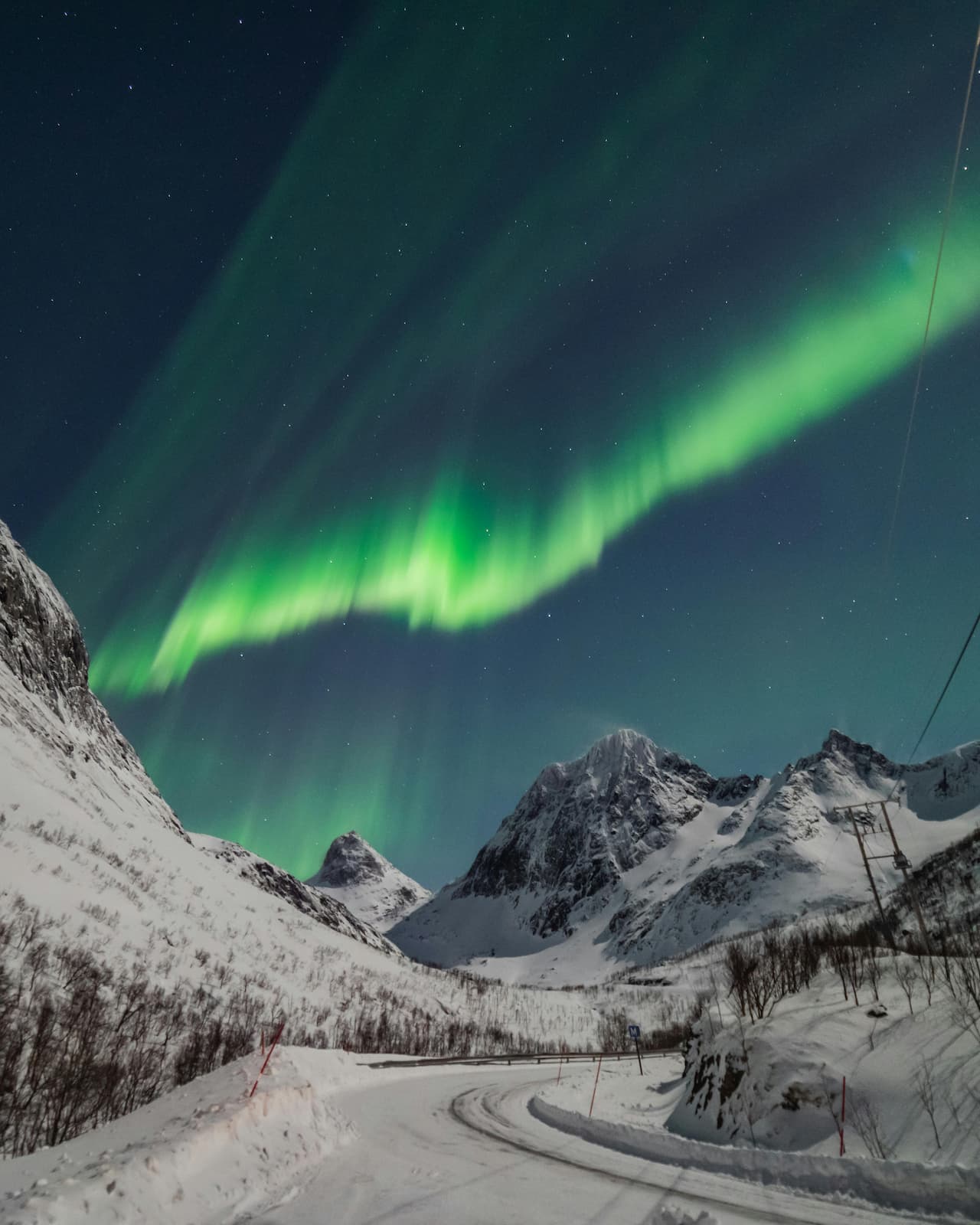
Most travelers who journey all the way to the Arctic with hopes of witnessing the Northern Lights never actually see them.
That’s the part the glossy brochures conveniently skip. They show you emerald skies shimmering above a glass igloo and let you assume the aurora is guaranteed if you simply show up. It isn’t. Seeing the Northern Lights is never about choosing a country on a map — it’s about understanding the handful of factors that truly determine whether the sky performs while you’re standing beneath it. And most trips, even well‑intentioned ones, aren’t planned around those factors at all.
After years of designing Northern Lights journeys for clients, I’ve seen exactly where these trips succeed and where they fall short. The pattern is remarkably consistent. When you plan with intention — the right timing, the right location, the right flexibility — the Arctic rewards you. When you don’t, even the most beautiful itinerary can leave you staring at a perfectly dark, perfectly empty sky.
My role is to make sure your experience is the first kind, not the second.
How I plan a Northern Lights trip
When a client comes to me for the Northern Lights, here is what I am working through before I propose anything.
The season comes first. The aurora needs long, dark nights, and the real window across the Arctic is narrower than the marketing suggests. Travel outside it and the trip is fighting itself before it has started.
Where you base comes next. The right answer is rarely the most photogenic lodge in the brochure. It is the one positioned for clear, dark skies and connected to a guide who knows how to move with the forecast. A beautiful base in the wrong spot is the most expensive way to look at clouds for a week.
The operator matters as much as the location. The good ones treat aurora viewing as a chase, not a tour. They have real flexibility for when conditions change overnight, and they know the territory well enough to relocate quickly when the forecast tells them to.
And then there is the part I make sure every client hears from me before we book anything. Nobody can promise the aurora, and I will not pretend otherwise. What I can do is stack every odd in your favor, between the right base in Norway, Iceland, or Finland, the right operator, and an itinerary built around what actually decides whether you see the lights. The trips I plan are designed for that. Most trips are not.
Why most Northern Lights trips fail
The trips that disappoint almost always make the same mistakes:
- Going in the wrong months. The aurora needs long, dark nights. Travel outside the real season and you have lowered your odds before you have left home.
- Basing in one spot and refusing to move. Weather is local and it changes. A trip with no plan to relocate toward clear skies is a trip betting everything on one patch of sky.
- Treating it like a fixed-schedule tour. Aurora viewing rewards flexibility. A rigid day-by-day itinerary cannot react to the one clear night in a cloudy week, and a cloudy week is exactly what you can get.
- No flexibility built in at all. The single most common failure. Great aurora trips are designed around the forecast. Most trips are designed around a brochure.
- Choosing the destination on looks. The most photogenic lodge is not automatically in the best position for clear, dark skies. The two are not the same thing, and confusing them costs you the trip.
What actually works
The flip side is just as clear, and it is where planning earns its keep:
Go inside the real season, when the nights are long and dark enough across the Arctic. Pick a base in Norway, Iceland, or Finland chosen for sky conditions, not just for the photos. Build in the ability to chase the forecast, so a clear night two hours away is something you can actually go after instead of watch slip by. And accept the one thing nobody can sell you: there is no guarantee. What you can do is stack every odd in your favor, and that is entirely a planning problem.
That is the whole game. The place matters far less than how the trip is built around it. My clients learn that from me before they leave home, not after they get back.
This is true of every expedition, not just the aurora
The Northern Lights are the clearest example, but the lesson is the category, not the destination.
The best small ships in Antarctica sell out more than a year ahead, and the prime departures go first. Patagonia has a narrow season and a wide gap between a good lodge and the right one. Across expedition travel, the difference between an excellent operator and a mediocre one is enormous, and you usually cannot see it from the outside until you are already there and it is too late to change anything.
This is exactly why we built out our luxury expedition travel planning the way we did. Expeditions are the trips where doing it yourself goes wrong in the most expensive, least recoverable way.
Why this is the trip to plan with an advisor
For a beach week, planning it yourself costs you a little convenience if you guess wrong. For an expedition, guessing wrong costs you the trip, and these are not trips you casually do over.
This is the category where the stakes of getting it wrong are highest and the differences between options are the hardest to judge on your own. An advisor who works in this space knows which operators deliver, how far ahead the good departures really book, and how to build in the flexibility the aurora and the ice both demand. You also have someone to call if something changes while you are somewhere remote, which on an expedition is not a small thing.
If the Northern Lights are on your list, or any expedition is, let’s plan it properly while there is still time to do it right. I will tell you honestly what works, what does not, and what your odds actually look like before we book anything.